Friday, August 2, 2013

Obama Reactive, Not Proactive On Terror


Photo: Heritage.org
  President Obama and his administration are not being proactive, but reactive once again in foreign policy issues such as international terrorism.  The US received intelligence on potential terror attacks at U.S. embassies, tourist locations, or on infrastructure in the Middle East.  The US government issued a travel alert on August 2 in response to credible threats by terrorist groups, which will remain in effect until August 31.  In addition to the alert, multiple embassies are to close August 4.  The closed embassies focus around the Middle East and northern Africa.  While the Obama administration is taking genuine precautions with the alerts and closures, Obama’s continuous downplaying of the stranglehold that extremist groups still have in the region has put American lives in constant danger.

  The attack on the U.S. consulate in Benghazi on September 11, 2012 is still being investigated as a failure of response on part of both the White House and State Department with the subsequent cover-up of the event as a terror attack.  The President, former US ambassador to the UN Susan Rice, and former Secretary of State Hillary Clinton all cited a video as the cause of protests that became violent.  We now know that was a complete fallacy conjured up by the administration.  
Photo: NPR.org
CNN recently confirmed that there were CIA agents on the ground at the time of the attack.  This raises more questions, and verifies that the motives for a cover-up may be even worse than the initial reelection strategy theory.  Even after President Obama proclaimed the demise of Al-Qaeda, American civilians and soldiers alike are still being killed by this gross negligence of foreign enemies. 


  Almost one year after the Benghazi terror attack, the most recent alerts were issued at a time when Secretary of State John Kerry is in the preliminary stages of Middle East peace talks.  One could find it quite ironic Secretary Kerry is beginning peace talks for a region where the State Department issued alerts and embassy closures.   One must contemplate how the Obama administration plans to use US influence to continue peace talks and see progress when the government is closing embassies and issuing severe alerts.  While it is important to protect the safety of Americans both abroad and at home, especially with credible threats, it seems Obama is abandoning American power in the region.  With fledgling democracies in Iraq and Afghanistan, a possible nuclear Iran, and civil unrest in Egypt, Syria, and many other Middle Eastern nations, decreasing American influence may increase the impact extremists have. 

  The Obama administration may have ‘learned’ not to abandon Americans in need of assistance with the Benghazi attack.  However, President Obama, as usual, may be taking this lesson to a whole new level.  With credible threats, it would seem plausible to increase visible security forces at our embassies; and should a situation occur, to protect and defend the lives of Americans.  Obama has no plans to do so.  He had led from behind on many previous issues in the region, and this is no exception.  Obama is simply being reactive to terrorist threats, not proactively providing increased security and tracking down the actual terrorists accordingly. 

  The administration may believe they are taking necessary steps to provide safety to Americans abroad; however, closing embassies for one day will not simply eradicate the threat of terrorism, especially when the closures are broadcasted to the whole world.  It is this mindset of a diminished threat from Al-Qaeda of which may have been the root cause of Benghazi as well as the lies that followed, the Boston Marathon bombing, and countless other situations. 
Boston Herald Cover - Obama knows 'nothing.'
The President needs to be more proactive with American influence throughout the world; particularly in the Middle East, not reactive to potentialities.  Closing embassies may give the terrorists ammunition in recruitment, saying Americans are scared of them.  That’s precisely what extremists want –a weak or even non-existent American influence.  Downplaying the strength extremist groups still have is ultimately dangerous to the safety of Americans.  It is unsettling the country reelected a leader without a backbone, who time and time again seems to have no clue about what’s going on in the world, much less in his own administration.   However, Americans should remain strong, and continue to proactively defend and promote ideals like liberty, justice, and freedom; even if our president won’t. 


Published: Freedom Weekly, August 7, 2013, Vol. 003 Issue 016


Friday, June 28, 2013

SCOTUS Upholds Election Integrity


Photo Courtesy Of NPR.org
    Election integrity is essential in American politics.  Many see the Voting Rights Act as a step to ensure election integrity; however, the Supreme Court disagreed.  On Tuesday, June 25, the Supreme Court struck down parts of the Voting Rights Act in a 5-4 decision.  The Supreme Court decided to strike down section 4 of the act, which requires nine mostly Southern states with histories of minority voter intimidation or disenfranchisement to seek federal approval before changing election laws.  Required federal approval was needed to change election procedures such as registration, redistricting, and Voter ID laws.  This may not mean the end of complete federal oversight, but it is improbable that the lack of federal oversight will damage election integrity in modern times. 


  While the GOP was relatively content with the decision, Democrats were highly disappointed in the court’s ruling, often citing civil rights movements and leaders.  Justice Ruth Bader Ginsburg stated the progress achieved in civil rights was “disserved by today’s decision” about her dissenting opinion.  Chief Justice John G. Roberts wrote in the majority opinion, “Our country has changed.  While any racial discrimination in voting is too much, Congress must ensure that the legislation it passes to remedy that problem speaks to current conditions.”  The majority opinion holds that any required federal oversight of voter laws must be based on current information.  However, with Democrats controlling the Senate, and Republicans controlling the House, it is unlikely an agreement for any federal oversight on state voter laws will be found.

Voting Rights Act Clearance Required - Wall Street Journal
  Alabama, Alaska, Arizona, Georgia, Louisiana, Mississippi, South Carolina, Texas, and Virginia are now able to change voting laws without required federal approval.  On June 27, the Supreme Court threw out a lower court’s ruling that Texas voter identification laws and redistricting could not take effect without federal approval.  The court’s ruling may also affect other states enacting voter identification laws.  

 Wisconsin’s voter ID bill was passed in 2011, but was ordered stopped from taking effect by Dane County Circuit Judge Richard Niess.  On May 30, 2013, the 4th District Court of Appeals in Madison overturned the circuit court’s decision in a unanimous decision that it did not violate the Constitution.  The groups who initiated the lawsuit against the bill are considering challenging Wisconsin voter ID in the Supreme Court.  However, because the Supreme Court recently threw out a similar lawsuit blocking Texas voter ID, it is unlikely they will hear the case.  The Supreme Court also upheld the Constitutionality of voter identification laws in Crawford v. Marion County Election Board in 2008.  This signals that the Wisconsin voter identification law will indeed go into effect. 


 The Supreme Court’s decision to strike down required federal oversight is a victory for election integrity.  In these modern times, racial prejudices and minority voter disenfranchisement at the polls simply does not happen on a large scale.  Indeed, it is time to stop punishing Southern states for the injustices of a generation ago.  The ruling will help many states to enact voter identification laws to ensure the integrity of elections, without much, if any, federal oversight.  Implications of the decision will not only affect those nine states that used to require federal approval in election law changes, but will affect all 50 states.  States can now enact laws which benefit election integrity, which ultimately will ensure the integrity of American politics. 


See also:

Freedom Weekly News 

Published: Freedom Weekly, July 24, 2013 Vol. 003 Issue 015

Thursday, May 16, 2013

2014 Senate Elections: Impending Disaster For Democrats


U.S. Senate Seats Up For Reelection 2014 courtesy of rasmussenreports.com
  In times where the majority of Americans are screaming for the repeal of the Affordable Care Act, investigations into White House scandals, and for a simple budget, the calls for action are seemingly unheard in Congress.  With a Republican controlled House and Democrat controlled Senate, as well as a president who bitterly divides the nation; it is difficult to pass anything, including a simple federal budget.  The GOP had an opportunity to take control of the Senate in 2012 but failed to do so.  However, 2014 looks to be a promising year for conservatives.  The GOP is not only set for Senate gains, but also a Senate majority. 

  Despite efforts by the Republicans, the lack of success in taking the Senate in 2012 was not a party failure.  The Senate seats up for reelection were largely in solid red or blue states. 
113th Senate Party Affiliation courtesy of Wikipedia
  The 2012 Senate elections, by default, presented little opportunity for either party to make gains; which assured the status quo.  Yet Republicans kept a strong majority in the House, which is a promising sign for the 2014 Senate elections; since only 1/3 Senate seats are up for reelection every 2 years, whereas all House terms are up in the same time frame.  In 2014, there are 33 Senate seats up for reelection; 13 Republicans and 20 Democrats.  Democrats are more vulnerable to lose seats simply because more of them are up for reelection.  Most Republican seats are in solidly red states.  Many Democrat Senators up for reelection in 2014 were ushered in with the overwhelming Obama support in 2008; many of whom are in swing states or even right-leaning states.  As in most non-presidential election cycles, conservative voters tend to overwhelmingly out-vote liberals.  It is the perfect storm for conservatives.

Senator Max Baucus (D-MA)
  Taking a look Senate seats up for reelection in 2014, there are many states in which Democrat Senate seats are not only threatened, but have a high probability of loss to the GOP.  In Montana, generally a red state, Democrat Senator Max Baucus, cosponsor of the unpopular Affordable Care Act, is retiring.  If he were to seek reelection, he would most likely lose because he called Obamacare a 'train wreck,' despite his apt sponsorship of the bill in 2009. 
 
Senator Mary Landrieu  (D-LA) 
  In Louisiana, Democrat Senator Mary Landrieu has a 47% approval rating.  While her approval is not terrible, it is also not good.  The incumbent Senator has faced declining approval rating since her last reelection in 2008, not to mention she is in a red Southern state.  She has been in Congress since 1997.  This would work to her advantage if she did not have stiff competition from the right. 
Representative Dr. Bill Cassidy (R- LA)
Dr. Bill Cassidy, currently representing Louisiana's 6th House District of greater Baton Rouge, is wildly popular in Louisiana, and won reelection with nearly 80% of the general election vote in 2012.  Should he cruise to an assumed primary victory, he will most likely beat Senator Landrieu.

  Even Democrat Senator Dick Durbin's seat is in danger.  The Illinois Senator won reelection in 2008, and like Louisiana's Landrieu, has been battling declining approval ratings.  One might say Illinois is 'too blue'; however Illinois has a tendency to elect Republican Senators like Mark Kirk or Peter Fitzgerald in non-presidential election years.   And there are many other Democrat Senators in strikingly similar reelection situations.

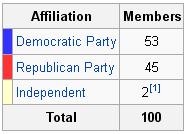
  With the current party affiliation of the Senate, Republicans would need to keep the current 13 seats as well as pick up only 6 of the 20 Senate seats currently held by Democrats. 
U.S. Senate Party Affiliation courtesy of Wikipedia
This would result in a slim 51-47 Republican majority with 2 Independents who caucus with the Democrats.  But because most GOP Senate seats are relatively safe, and because many Democrat Senate seats are threatened, it would come as no surprise if the GOP picks up a larger senate majority in 2014.  This possibility will enable Republicans to attempt to fix the mess President Obama has created.  Repeal of the Affordable Care Act, sincere and effective federal budget cuts, and even a possible full impeachment of the president, as scandals continue to mount.  With a Republican controlled Senate in 2014, the voice of the majority of Americans may finally be heard loud and clear.        


See also: U.S. Senate Conservatives Fund

Thursday, April 25, 2013

Terrorism And The Threat To Milwaukee

 
Photo Credit: Dan Lampariello
  On April 15, the United States of America suffered the first successful terrorist attack on innocent civilians in the homeland since 9/11. The gruesome images from the Boston Marathon bombing will be forever engrained in the minds of Americans. As the investigation into the suspected terrorists moves forward, one thing is clear; the bombers were radicalized Muslims who blended into American society. FBI sources say that the bombers’ methods, techniques, and training are sophisticated enough to suggest they may be part of a larger sleeper cell organization, with possible ties to Al-Qaeda. Sleeper cells can go undetected or overlooked in any American city, including right here in Milwaukee. If terrorist sleeper cells that have blended into society become active, is Milwaukee safe? 

  To answer that question, one must look at factors of metropolitan preparedness, risk analysis, and Milwaukee’s methods of risk mitigation. Emergency preparedness for a terrorist event, accident, or natural hazard is the first line of defense in minimizing potential for loss of life and property. Emergency management officials say that every citizen should have basic items on hand in the event of an emergency, such as water, food, and first aid kits. In extreme emergencies, Milwaukee metropolitan counties would operate under an incident command system to coordinate efforts. Mutual aid agreements, protocols, and standardized operations exist to mobilize local, state, and federal resources as needed. First responders of every county have training in responding to any emergency event, including a terrorist attack, and participate in drills to recreate the chaos following a terrorist event. 

  Most wouldn’t think of Wisconsin as a potential Al-Qaeda target; however the marathon bombings show us that any event in any city is a potential target for people who are indiscriminant in killing. Wisconsin Homeland Security has dealt with droughts, floods, and hazardous accidents in the past, and recognizes the risk of terrorism in Wisconsin. Wisconsin has a reputation as an agricultural center, and proximity to Chicago and Minneapolis add additional risk to Wisconsin population centers. Because 5 of the 10 largest cities in Wisconsin are in the Milwaukee metro area, these population centers put Southeast Wisconsin at a greater risk for a terrorist attack. Risks include Wisconsin’s critical infrastructure, public gathering sites, large water systems, utilities, agriculture industry, and critical manufacturing sites. A Wisconsin Hazards Vulnerability Report uses factors such as probability, preparedness, and impact to create a relative threat risk. The relative threat risk to Milwaukee metro for a radiological attack is 63%, which is lower than the multiple vehicle highway accident relative threat of 52%. An influenza pandemic received the highest relative threat score of 81%. Officials maintain that the largest threats to the Milwaukee metro are influenza pandemics, rail accidents, and extreme weather. 

  Terrorism and sleeper cell potential has prompted authorities to take a proactive stance on risk mitigation. Waukesha County Emergency Management Coordinator William Stolte explains that Waukesha County trains first responders to maintain situational awareness in a terrorist event, including awareness on secondary devices and hazards. Sheboygan County conducts frequent drills and exercises under county Director of Emergency Management Steven Steinhardt. One exercise included the annual NASCAR Nationwide event hosted in the county. 

  Event planning is key in minimizing security risks at public gatherings. Steve Fronk, Milwaukee Director of Emergency Management helps event organizers with security. Fronk also leads a group called Urban Area Security Initiative, a federal grant program for 5 metro counties to assess security risks and potential regional impacts. Any response to a terrorist attack would be event dependent. Specifics of response plans were not given to protect first responders. However, the Milwaukee Sheriff’s Department doesn’t believe security and event planning were the issues in Boston. The Sheriff’s Department is concerned with the lack of intelligence coming out of local fusion centers, which relay information to authorities. Sheriff David Clarke believes there are mounting counterterror intelligence issues. This comes after the grant program designated to Milwaukee for terrorism response was cut due to federal risk analysis. With decreased federal funding for local intelligence gathering, authorities must rely on a vigilant and aware public. WI Watch is a local program where citizens are urged to report any suspicious activity to counter terrorist threats. WI Watch, in conjunction with federal programs like the ‘If You See Something, Say Something’ campaign urges the public to report suspicious activities and behavior to authorities. An aware public is the best way to minimize terror related risks. 

  The Milwaukee metropolitan area uses preparedness, risk assessments, and first responder training to prepare for emergency situations. The cooperation between metro counties ensures Milwaukee is a generally safe city. However, after the terrorist attack in Boston and ensuing manhunt which shut the city down, officials are not willing to downplay terrorist risks to the Milwaukee area. Increased security measures in neighboring Chicago may make the Milwaukee area a more attractive target for terrorist sleeper cells. A vigilant and aware public may just be the deterrent needed to avoid terrorism in Milwaukee. If you see any suspicious activities or behavior, report it to 1-877-WIWATCH. Together, we can minimize the risk of terrorism and keep the Milwaukee metro area safe.

Freedom Weekly, April 2013 Vol. 003 Issue 009

"Terrorism And The Threat To Milwaukee" Special Thanks

Most of the information obtained for the article "Terrorism And The Threat To Milwaukee" was obtained through the cooperation of the following individuals and organizations.  On behalf of Freedom Weekly and myself, I thank you for your time in answering questions on Emergency Preparedness!

Milwaukee County Sheriffs Department

Milwaukee Police Department

Waukesha County Emergency Management

Wisconsin Emergency Management

Wisconsin Department of Homeland Security

Wisconsin Department of Health and Human Services

Mark Stanmeyer
Sergeant, Milwaukee Police Department

Lori Getter
Crisis Communications Manager, Wisconsin Emergency Management

William Stolte
Coordinator, Waukesha County Emergency Management

Fran McLaughlin
Public Information Officer, Milwaukee County Sheriff's Office

Steven Steinhardt
Director of Emergency Management, Sheboygan County Sheriff's Department

Edward Van Tine
Director of Emergency Management, Kenosha County Sheriff's Department

Steven Fronk
Director, City of Milwaukee Emergency Management and Homeland Security


Thursday, April 11, 2013

The 2016 Dark Horse


  After a tough election loss, a political party’s pride can be momentarily deflated.  To invigorate party pride, chatter begins about possible candidates for the next election cycle.  Even well before the midterm elections, both the Republicans and Democrats are on a quest to find their 2016 presidential candidates.  Yet there is a lot of time between now and the midterms, much less the presidential election.  While the most obvious choice for Democrats at this point is Hillary Clinton, similar to 2008, there very well could be a dark horse to come into the picture and edge out other leading candidates.  The Republican Party may very well have its own dark horse candidate who will win GOP nomination, and he is right here in America’s Dairyland. 


  Governor Scott Walker could potentially be the dark horse Republican nominee for the 2016 presidential election.  Elected in 2010, Scott Walker will face reelection in 2014.  The left will once again try their hardest to oust the governor.  Despite the left’s best efforts, Governor Walker won the vote in 60 out of Wisconsin’s 72 counties.  Wisconsin may have gone ‘blue’ in November with Baldwin and Obama, but the GOP gained majority in the state assembly and senate.  These conservative leaning trends make it unlikely the Governor will be unseated.  That does not mean reelection will be easy.  But Scott Walker is certainly a fighter, and a winner at that.  The Governor will be ready for the national stage, and the progressives may have actually helped him with the national exposure during the recall elections. 
             
  Scott Walker would pose a great threat to the Democrat presidential nominee, and would be more likely to run a winning campaign any other candidate.  He poses a triple threat to the Democrats: personality, ideals, and accomplishments.  Scott Walker is approachable, listens to the opinions of others, and easily relatable to the everyday American.  Walker also has the tough skin required to be on the forefront of controversy.  Situations where progressives run and hide in other states like fugitives, Walker admirably takes up the fight.  He fights for what he believes is right without ignoring dissenting opinions.  His political ideology and supporting arguments may be exactly what the Republicans need.  With so much GOP infighting, Scott Walker has the ability to unify the party with his modern Reaganesque views.  Walker’s ideology takes shape through his practical approach to problem solving and willingness to roll up his sleeves to get things done.  Walker fought the union fat cats by ending collective bargaining, and again by winning the recall election.  He supports legislation that adheres to fairness like the voter ID bill.  Walker opened Wisconsin for business, which was greatly suffering under his predecessor Jim Doyle.  In 2010, Walker made a pledge to create 250,000 jobs.  He is well on his way with nearly 70,000 jobs created, with far more to come by infrastructure investments, reformed education, and the passage of the mining bill.  Scott Walker has a proven track record of which to proudly stand by.  


  Governor Scott Walker offers all of the right qualities that our nation deserves in a president.  While many are touting libertarians like Rand Paul and Ted Cruz, they lack the unifying nature that a candidate like Walker has.  Andrea Tantaros, cohost of The Five on Fox News, subtly touched on this point by saying she liked the Wisconsin governor during a discussion on potential 2016 candidates.  Much like Louisiana Governor Bobby Jindal, Scott Walker is more likely to go after every vote rather than segmenting voters into winnable and non-winnable blocs.  It’s time we get an executive back in the White House.  Should Governor Scott Walker decide to run for the Republican presidential nomination, Wisconsinites may have to start sending Christmas cards for the governor to 1600 Pennsylvania Avenue.  Scott Walker could be a true dark horse candidate in 2016 should he decide to run.  President Scott Walker.  What pride a Wisconsinite would feel hearing that every day!

Freedom Weekly, April 10, 2013 Vol. 003 Issue 008